Jeju's Industry Speaks - Strategy Forum Connecting Trends, Institutions, and Clinical Trials in Cosmetics
In an era where trends and regulations in the cosmetics industry change rapidly, a platform was created to discuss how practitioners can cope with these changes. At the '2025 Cosmetic Inspiration' event, discussions ranged from market trends to product realization strategies, all centered around practical applications.
Cosmetic Inspiration in Jeju: Questioning the Direction of the Industry
On November 28, 2025, the '2025 Cosmetic Inspiration' event was held at the advanced campus of Jeju Industry-University Convergence District. This special seminar brought together local cosmetics industry personnel, students, and institution officials. The venue was filled with a diverse group of stakeholders from Jeju, including responsible sellers and startups, all pondering the same question: What should we prepare for now?
Participants shared practical strategies around the core industry keywords of 'trend,' 'regulation,' and 'clinical trials'. Presentations were structured not just as isolated information but as a flow from product planning to launch, providing practical assistance. The session began with '2026 Cosmetic Trends and Proposal Formulation', followed by 'Readiness Strategies for Cosmetic Safety Evaluation Systems', and then 'Securing Human Application Test Data'.
2026 Trends and Formulations: Meeting Market Demands
The first session introduced upcoming 2026 cosmetic trends. Trends are not just about following fashion but involve insights into consumers' lives and behaviors. The key was analyzing which sensory experiences are beloved and which formulas are likely to last longer. This presentation extended beyond just listing trends to include practical suggestions with formulation samples.
Product planners need the ability to read the market and design products to match that flow. The presentation, based on such insights, suggested directions for brands to maintain competitiveness while pursuing new challenges. Formulations also evolved, with ideas such as velvet oil formulations and multi-layer mist serums responding to sophisticated sensory experiences.
Safety Response and Institutional Strategy for Responsible Sellers
The second session focused on 'Understanding and Preparing for Cosmetic Safety Evaluation Systems', addressing how the industry should respond to institutional changes. The timing now requires finding answers about responsibility rather than just product ownership. The session systematically introduced key evaluation standards and preparation stages responsible sellers need to know.
"Safety must be the foundation of products. You can't get ahead of trends, but falling behind will lose market trust."
Though regulatory responses may seem hard and austere, the presentation broke it down into practical language, helping attendees apply it to their individual situations.
Why Human Application Tests and Marketing Clinical Trials Matter
The third session focused on how to use data from human application tests, i.e., 'clinical trials', as marketing tools. Clinical trials are the strongest means to prove a product's scientific bases. However, the challenges lie in cost and time.
"Today's market can't rely solely on emotions. Trust driven by numbers is essential."
A dermatology research institution outlined what companies need to prioritize in actual human application tests, and how to navigate regulatory hurdles. Emphasis was on adapting clinical compositions according to currently popular product categories. Strategies for targeted fields like whitening, wrinkle improvement, and moisture retention were presented with case studies.
Formulation Sample Exhibition: Realizing Product Designs in Tangible Forms
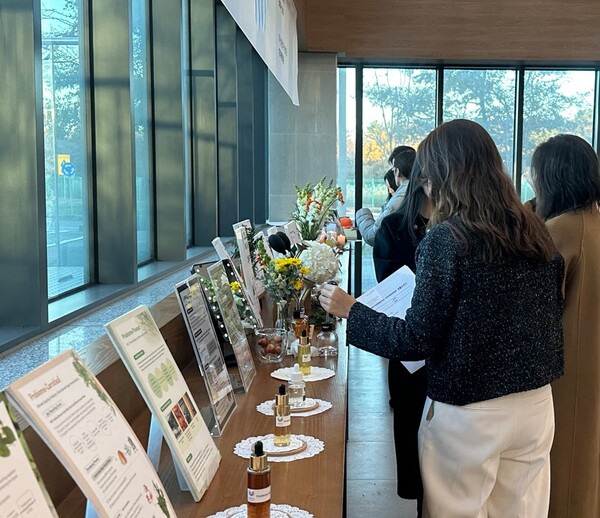
After the official program ended, the seminar space continued to bustle, particularly in the lobby where formulation samples discussed during the presentation were on display, allowing attendees to see and feel them firsthand. The exhibited products included a series using patented fragrances, light-textured oil essences omitting the emulsification process, and mist serums with layered gels, reflecting the forefront of market trends.
Participants engaged in exchanges much like discussing immediate concerns with developers, contemplating which points should be emphasized from a planning perspective. This hands-on experience went beyond mere exhibition, serving an educational function and acting as a bridge to new ideas and field applicability.
Startups and Potential Entrepreneurs Enhancing Practical Skills
Notably, many companies preparing to enter the responsible sales sector and early-stage startups participated, drawing considerable attention. They recognized the necessity of acquiring proactive information and strategies in establishing their position amidst uncertainty and rapid changes.
The seminar, with its emphasis on practical applications, proved particularly beneficial for them. They confirmed that insights for product ideas could be found even within the rigid contexts of regulations and rules, and the practical approaches to linking clinical trials with marketing caught their interest. The structure of considering both regulations and markets from the early project planning stage is expected to greatly impact future competitiveness.
Student Participation as a Field-Based Learning Opportunity
A significant number of students from Jeju University's Chemistry and Cosmetics Department attended, gaining invaluable exposure to the field-based structure of the cosmetics industry. The experience of listening to explanations from faculty and institutional representatives, observing product samples, and engaging in Q&A was part of practical preparation for future work.
"Opportunities like this help us understand the academic-industry field outside the lab. It made us experience the connection between theory and reality."
There were also natural discussions around potential collaborations between academia, industry, and institutions. Universities provide the technical groundwork, industries suggest commercial possibilities, and institutions manage risks and regulations. This interlocking of the three areas is essential to carve out a place in the global market, a sentiment that resonated throughout the event.
Conclusion
'Cosmetic Inspiration' intertwined key issues such as cosmetic industry trends, regulations, and clinical data acquisition into a seamless flow, demonstrating a multidimensional approach spanning practice and strategy. The insights gained on-site went beyond mere information acquisition, helping us concretely envision the future directions we must prepare for.
This event, in partnership with , once again demonstrated the practical insights participants can gain for better preparation and growth in the cosmetics industry by tying various crucial issues into a pragmatic approach. Ultimately, such exchanges will significantly contribute to building an international market presence.

